Author: Dr. Tomaj Arian*
This article pursues two central questions: Can a foreign force (Israel) overthrow the regime of the Islamic Republic of Iran through a military attack, and if not, why doesn’t Iranian society take advantage of historical opportunities for widespread protest? And is it capable of doing this? To answer, I first review field reports and analysis on the June 2025 attacks and military-nuclear objectives, then, drawing on collective action theory and domestic historical evidence, assess Iran’s social and structural capacities for regime change.
Israel attacked Iran in June 1404, sparking a 12-day war. Israel destroyed all of the Islamic Republic’s nuclear infrastructure, including enrichment sites, centrifuge production, and killed a large number of the Islamic Republic’s commanders.
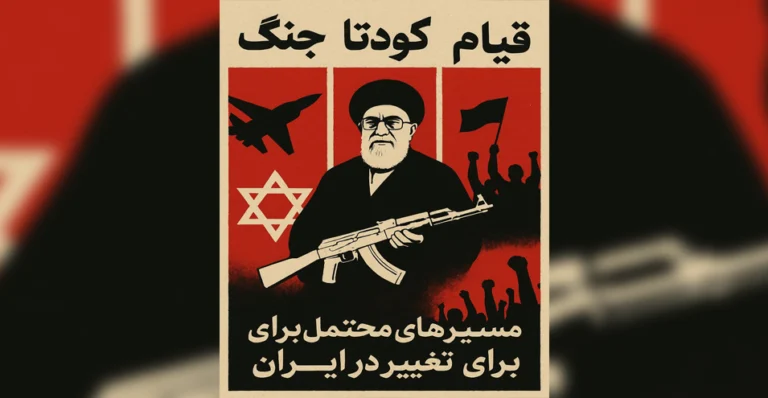
The question is, was the Israeli attack intended to overthrow the Islamic Republic? The answer is certainly no. The aim of the Israeli attack was only to destroy nuclear sites and assassinate individuals who were active in the nuclear and missile programs, and to paralyze the Islamic Republic’s response system. If Israel’s aim in this attack was to overthrow the Islamic Republic or prepare the groundwork for it, it should first assassinate the leader of the Islamic Republic, his son, his family, and the heads of Iran’s power, such as the president, the speaker of the parliament, and the head of the judiciary, so that the Islamic Republic’s head would be cut off and the preparations for a coup by some of the military or for people to take to the streets en masse and overthrow the Islamic Republic. But Israel did not do this.
Perhaps Israel had this intention in the final days of the war, but it was too late and the decision-makers were hiding underground.
Israel hoped that protests would begin at the same time as the destruction of the Islamic Republic’s nuclear and missile infrastructure. However, with the confusion of Israeli leaders in this matter, namely asking the people to evacuate Tehran, this goal failed, and Iranians did not join these protests throughout the country, and Israel made miscalculations regarding the psychology of the Iranian people and the priority of preserving lives in war.
Other things may happen in a possible future war, but the future cannot be predicted.
Therefore, we can conclude that there is no direct relationship between a possible future Israeli attack and the fall of the Islamic Republic, and we will see exactly the same reaction from the Iranian people in the future.
After the June attack, Israel has moved towards the complete overthrow of the Islamic Republic and will target the leaders of the Islamic Republic in a lightning attack at the first opportunity with the aim of overthrowing the Islamic Republic. The Israelis believe that by overthrowing the regime, the possibility of the Islamic Republic being overthrown spontaneously or by the people is very high, and they have taken steps in this direction and will implement it in the near future because with the Islamic Republic, Israel will not have long-term security, and all political groups in Israel are in agreement on this issue.
Now I will address the second question.
Why doesn’t Iranian society hold mass protests during historic opportunities? And is it capable of doing this?
Unfortunately, the people of Iran do not have a good relationship with public protest and prefer that others do their duty. These others are either other Iranians or foreign countries.
The Iranian nation is not a unified nation that can achieve a common goal, and this is because they see the root of social problems not as their own behaviors, but as factors other than their own behavior and culture, and this leads to a lack of motivation for collective action.
The majority of the Iranian people believe that the current unfavorable situation is due to the actions of others, especially foreign powers, and their expectation from the great powers is that they themselves will resolve this problem within Iran. This illusion of conspiracy and external causes is rooted in Iranian culture, and they believe that the problems are not due to their own behavior, but to other countries, and it has a history that dates back hundreds of years.
The majority of Iranians consider the 1979 Islamic Revolution to be the result of a foreign conspiracy by the United States, England, and France, and do not consider the overthrow of the monarchy to be the result of their own demonstrations of hundreds of thousands in 1979. In their minds, they expect the West to overthrow the Islamic Republic. Unfortunately, as long as this thinking exists, no major change will occur in Iran.
The Iranian nation is always looking for a savior. In 1979, they saw Ruhollah Khomeini as the savior and searched for his image on the moon. Now, they see Prince Reza Pahlavi, Israel, Benjamin Netanyahu, Donald Trump, and so on as the savior. Not taking any responsibility for oneself is a dangerous phenomenon for a society, and the Iranian nation has this characteristic.
Another issue is prioritizing personal interests over public interests. A large number of Iranians are dissatisfied with the current situation, but personal interests do not require them to join public protests and refuse to pay. We saw a concrete example of this in the protests of previous years, especially in 1401. At the peak of the protests across the country, up to one million people took to the streets, and about 88 million people chose silence and preferred personal interests, both material and human, over protest. Experience has proven that with this number of people, a totalitarian government does not fall, and brave individuals in society suffer greatly and, unfortunately, do not participate in subsequent protests.
The next issue is the Iranian opposition abroad, which has the least cooperation and teamwork, and after a while, they become divided and divided. A fragmented opposition with conflicting and destructive views cannot do much to unite the Iranian nation and the world against the Islamic Republic.
The opposition’s situation inside the country is better than outside the country, and in practice it performs better inside. Experience has shown that whenever the opposition outside the country takes the stage in public protests, it causes disappointment and despair among the people inside the country, and domestic protests subside and become distorted.
Another phenomenon that has greatly damaged Iranian civil society is the Islamic Republic’s systematic and pervasive repression, which has isolated and alienated political and social elites and activists within the country, forcing them to emigrate. This isolation and widespread emigration of elites and experts has left Iran devoid of influential individuals and has confronted political and social action with crisis and inaction.
The next issue is that modern individualism has increased sharply among Iranians, and this individualism has led to loneliness, isolation, and avoidance of collective actions, which has led to the failure to form civic groups and avoidance of collective work.
The Iranian people have not been a political society throughout history. The phenomenon of citizenship has a history of one hundred years, and in these one hundred years, the Iranian nation has tried to avoid politics. The Islamic Revolution of 1957 brought the Iranian people to the valley of politics and collective activism, and the failure of this experience caused a collective disgust to arise, and they tied misunderstood politics to the illusion of conspiracy, turning it into this current mess of writers. The result has been that they have distanced themselves from activism, given priority to personal interests, and sought help from Western powers to transform their society.
The Iranian people are not fundamentally serious about collective and political activism and are more interested in momentary joys and recreational gatherings. Simply put, the Iranian people are happy and cheerful people. Their social activism is going to nature collectively and grilling kebabs, chicken, and skewers. Political and social activism goes beyond this profession. If the Islamic Republic restores the economic environment, the majority of the Iranian people will not feel the need to protest and demand an open political space. Iranian history has proven that the majority of Iranian people watch and do nothing at critical times. The Iranian people will not soon become a political and responsible nation.
Given the question for these two answers, now the main question is: what solution is there to overthrow this government?
The answer can be sought in Israel’s motivation, the fragmentation of the Islamic Republic, and the agitation of the people at critical moments.
After the June attack and seeing the weakness of the Islamic Republic’s power, Israel turned to a project of overthrow, and in the next attack, its goal is to eliminate the leaders of the Islamic Republic, or simply to behead the Islamic Republic. This issue has created panic among the officials of the Islamic Republic. They know that if the leaders are eliminated, the Islamic Republic may face an immediate collapse and all of their lives will be in danger.
Khamenei has made his choice: resistance until the last moment and a heroic death. He is at the end of his life and is suffering from mental illusions and wants to sacrifice himself for his delusional apocalyptic ideals. But most of the officials of the Islamic Republic do not have this view and in the middle of the next Israeli attack, there is a high probability that either Israel will kill Khamenei and the senior officials will carry out a coup at that moment or in the middle of the next attack, the officials will force Ayatollah Khamenei to resign or kill him out of fear for the future. In both cases, a coup within the government will occur, the probability of which is very high considering Khamenei’s suicidal behavior. This coup could save the lives of the officials of the Islamic Republic and make agreements with the West that the West will certainly accept and end the war and the Islamic Republic will continue.
Another possibility is that in the middle of the next war, with Khamenei and senior officials killed, people, albeit in small numbers, will take to the streets and mix war and demonstrations. As the protests continue, more people will join the protests throughout Iran, and the Islamic Republic will be overthrown instantly.
Of these two options, one will happen and the other is unlikely. As long as Khamenei is alive, the system of repression will operate at full strength and suppress any protest, so the other options are out of the question.
The future is either in the hands of coup plotters within the Islamic Republic and a change in the course of the Islamic Republic, or public protest in the next possible attack and the immediate overthrow of the Islamic Republic.
The balance so far is in favor of a coup during the war and the killing or removal of Ayatollah Khamenei by the authorities of the Islamic Republic. This is because the survival motive for the authorities of the Islamic Republic to take immediate action is stronger than the collective motivation of the Iranian people to overthrow the Islamic Republic.
End
*PhD in Political Science, Writer, Political Analyst